How Nintendo’s Betrayal Accidentally Created the PlayStation — The Untold Story of Gaming’s Biggest Twist
Introduction
In business, some decisions cause losses — but a few create new legends and powerful rivals.
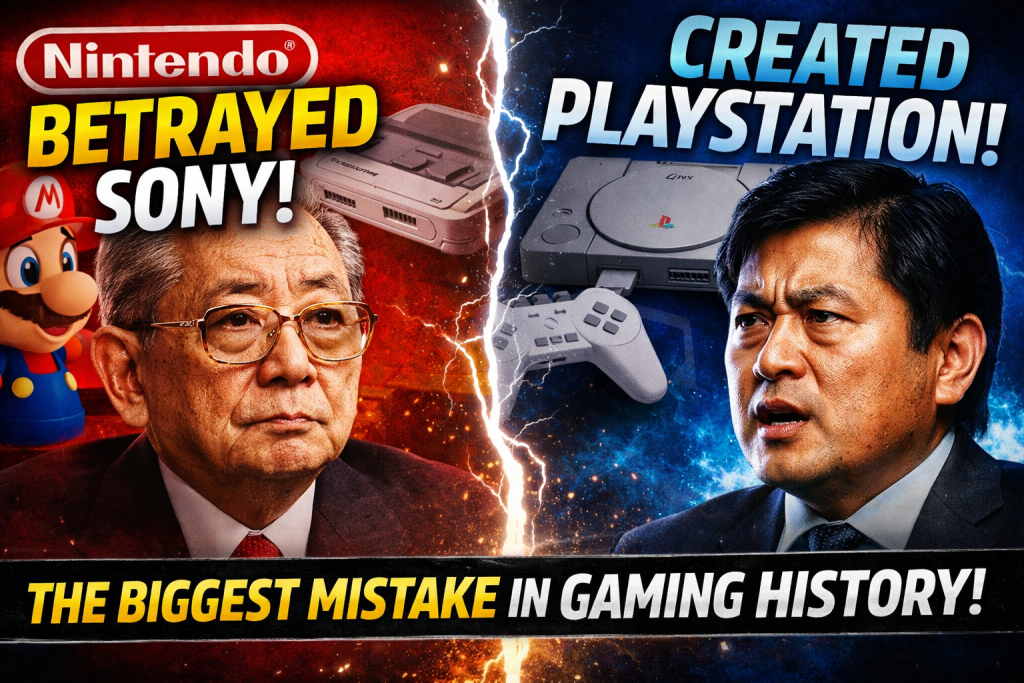
That’s exactly what happened in 1991, when Nintendo publicly betrayed Sony, triggering events that led to the creation of the PlayStation — a console that would dominate gaming for decades.
This article explores the true story behind the Nintendo–Sony fallout, the secret Philips deal, and how revenge and innovation birthed the PlayStation.
Nintendo — The King of Gaming in the Early 1990s
During the late ’80s and early ’90s, Nintendo was the undisputed leader of the gaming industry:
- NES and Super Nintendo ruled the market
- Mario, Zelda, and Metroid became cultural icons
- Nintendo controlled most of the global console market
Nintendo operated on one core philosophy:
“Control the games. Control the hardware. Control the ecosystem.”
But technology was evolving — and cartridges were becoming outdated.
The Rise of CD-ROM Technology
Cartridges were:
- Expensive to manufacture
- Limited in storage
- Restrictive for developers
Meanwhile, CD-ROM technology offered:
- Higher storage capacity
- Lower production cost
- More flexibility for 3D and cinematic gaming
Nintendo needed CD technology — but didn’t have it.
That’s when Sony entered the picture.
Sony and the Vision of Ken Kutaragi
Sony was known for Walkman, televisions, and audio tech — not gaming.
But inside Sony worked an ambitious engineer:
Ken Kutaragi — The Man Behind PlayStation
He secretly designed an advanced audio chip for the Super Nintendo, impressing Nintendo despite initial resistance.
This led to a historic collaboration:
The “Nintendo Play Station” Project
The plan was to build:
- A CD add-on for the Super Nintendo
- A hybrid console supporting cartridges and CDs
Under the agreement:
- Nintendo controlled games
- Sony controlled the CD system and licensing rights
And that clause sparked fear inside Nintendo.
Why Nintendo Became Afraid of Sony’s Growing Power
Nintendo had always maintained strict control over licensing and royalties.
But in this partnership:
- Sony would gain significant influence
- Developers might rely more on Sony
- Royalty power could shift away from Nintendo
Executives feared:
“Sony may become stronger than us in gaming.”
Instead of renegotiating…
Nintendo secretly switched partners.
The Secret Philips Deal — Done Behind Sony’s Back
Nintendo quietly signed a new agreement with Philips — without informing Sony.
The strategy was:
- Use Philips for CD technology
- Gradually push Sony out of the project
But timing made the situation explosive…
The Sony-Nintendo collaboration was about to be announced publicly.
CES 1991 — The Public Betrayal That Shocked the World
At CES 1991, Sony proudly announced:
“We are working with Nintendo on the Play Station.”
The audience applauded. Media celebrated.
But the very next day, Nintendo made a shocking announcement:
“We are now partnering with Philips instead.”
Sony was never warned.
Sony was humiliated on the world stage.
This moment is remembered as one of the biggest betrayals in gaming history.
Sony’s Response — And Ken Kutaragi’s Determination
Many Sony executives wanted to quit gaming entirely.
But Ken Kutaragi refused.
He convinced leadership:
“Instead of backing down, we will build our own console —
and prove Nintendo wrong.”
This decision changed gaming forever.
The Birth of the PlayStation — Innovation Born from Revenge
Sony redesigned the system with a bold vision:
- No costly cartridges
- CD-based storage
- Developer-friendly tools
- Support for larger, cinematic, mature games
In 1994, Sony launched the PlayStation.
Developers loved it because:
- Games were cheaper to produce
- Storage capacity allowed bigger projects
- Sony welcomed third-party creators
Meanwhile, Nintendo stuck to cartridges with the N64, causing:
- Higher game costs
- Storage limitations
- Developers shifting to Sony
The result?
PlayStation dominated the gaming market.
PlayStation vs Nintendo — A Turning Point in Gaming History
PlayStation became a global success.
Then PlayStation 2 arrived — and became the best-selling console of all time.
Sony officially became:
- A gaming powerhouse
- Nintendo’s strongest rival
Ironically…
A rival Nintendo accidentally created.
The Failure of the Philips CD-i Partnership
Nintendo’s Philips deal produced:
- Poorly-received Zelda CD-i games
- Failed Mario experiments
- No SNES CD add-on release
The partnership delivered no real success.
Sony, meanwhile, built an empire.
Does Nintendo Regret Betraying Sony?
Nintendo remains successful today with:
- Unique consoles like Wii and Switch
- Strong first-party franchises
But one truth remains clear:
Had Nintendo not betrayed Sony at CES 1991…
PlayStation may never have existed.
That moment reshaped:
- The gaming business landscape
- Competition in console history
- The future of entertainment technology
Sometimes, a single corporate decision doesn’t just affect profits —
it rewrites history.
Final Thoughts
The Nintendo–Sony breakup proves that:
- Fear of losing control can backfire
- Broken partnerships can create powerful rivals
- Innovation can rise from conflict and ambition
Today, every time we pick up a PlayStation controller,
we hold a piece of history that was never meant to exist.
About The Author