🚀 The M5 Chip is Here: Apple’s Silicon Juggernaut Redefines Performance and AI
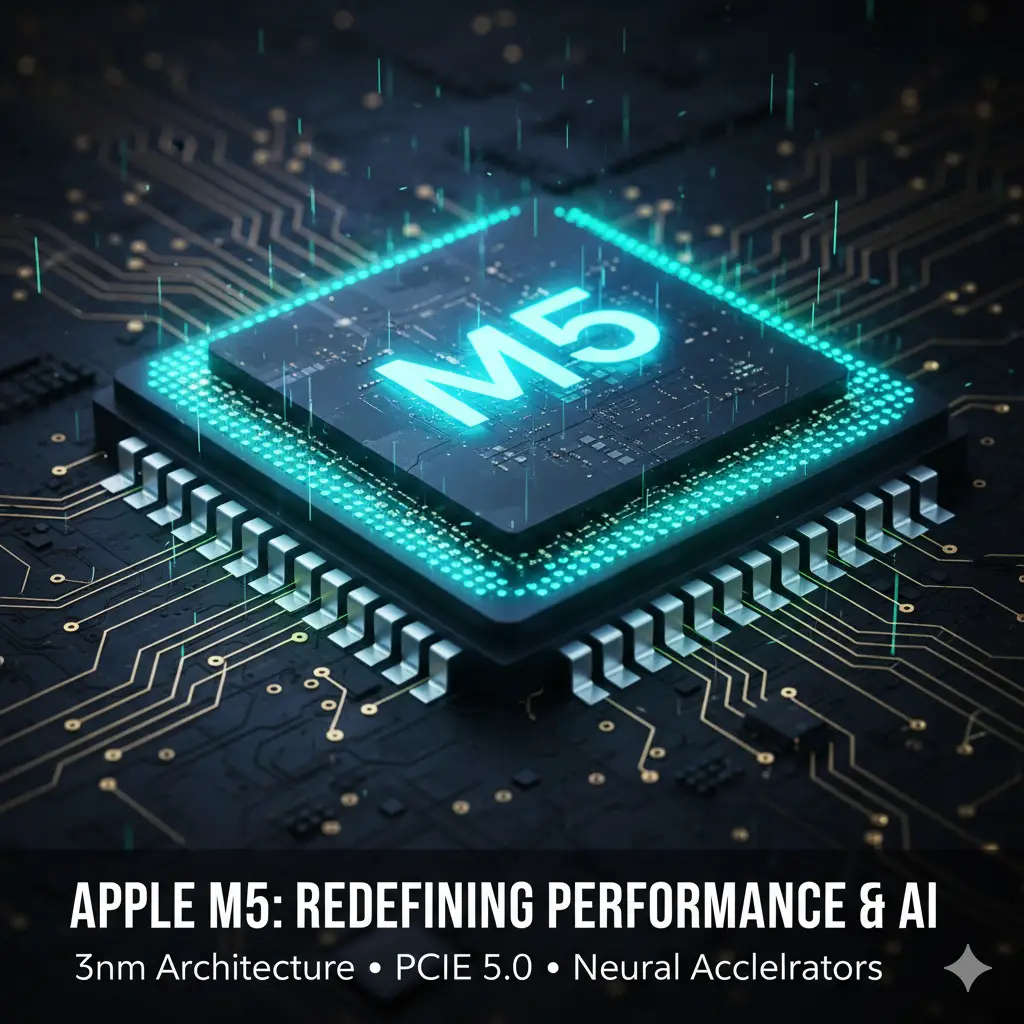
Apple has once again raised the bar for mobile and professional computing with the unveiling of the M5 Apple Silicon processor. Built on TSMC’s cutting-edge third-generation 3nm process, the M5 is not just an incremental update—it’s an architectural leap that delivers stunning performance across CPU, GPU, AI, and storage subsystems.
If you thought Apple’s silicon had peaked, prepare to be impressed. The M5 signals an aggressive push into next-generation performance and efficiency, setting a new benchmark for the entire industry.
🔥 The Core Specs: A Powerhouse Architecture
At the heart of the M5 is a powerful new configuration designed to handle the most demanding modern workloads:
- CPU: A 10-core configuration, featuring four high-performance cores and six high-efficiency cores.
- GPU: A new 10-core GPU that integrates advanced hardware ray tracing and neural accelerators directly into each core.
- Memory: Upgraded unified memory bandwidth reaching 153 GB/s, supporting up to 32 GB of unified RAM.
- Storage: A brand-new PCIe 5.0 SSD controller, effectively doubling storage bandwidth for lightning-fast disk I/O.
📈 Beyond the Clock: Performance Gains That Matter
Benchmark results from Geekbench confirm the M5’s generational dominance over its predecessor, the M4. But the gains are more than just raw speed; they reflect smart architectural decisions:
| Performance Metric | M5 Improvement vs. M4 | Key Architectural Driver |
| Multi-Threaded CPU | Up to 15% Faster | Focus on enhanced efficiency core performance and higher clock speeds (up to 4.6 GHz). |
| Single-Threaded CPU | Up to 10% Faster | Increased L2 cache (4MB to 6MB) for performance cores and higher Instructions Per Cycle (IPC). |
| GPU Performance | Up to 1.6x Faster | Redesigned GPU with second-gen dynamic caching, unified image compression, and new ray tracing engine. |
| AI Performance | Up to 3.5x Faster | Integrated neural accelerators within each GPU core for distributed, high-speed AI compute. |
⚙️ Deep Dive: Where Apple Invested Its R&D
The true story of the M5 lies in its strategic architectural enhancements, proving Apple’s balanced approach to power and efficiency.
1. The Rise of the Efficiency Cores
Unlike previous generations, the M5 places a noticeable emphasis on boosting the performance of its efficiency cores. This strategic shift significantly contributes to the impressive 15% multi-core performance gain, proving that Apple is optimizing for real-world, sustained, multi-tasking workloads rather than just single-core peak scores.
2. Next-Gen Graphics and Visual Fidelity
The 10-core GPU is a major redesign. The introduction of second-generation dynamic caching and unified image compression dramatically reduces bandwidth usage and power consumption. For users in gaming, professional graphics, and immersive experiences like the Apple Vision Pro, the enhanced ray tracing engine and improved shader cores are a game-changer for graphical fidelity and performance.
3. AI Compute Goes Hyper-Distributed
The most future-forward update is the integration of dedicated neural accelerators within every single GPU core. This heterogeneous architecture, in addition to the 16-core Neural Engine and CPU matrix units, allows AI workloads to be distributed optimally, skyrocketing peak AI compute to 3.5 times that of the M4. Developers can harness this immense power via the Core ML and Metal 4 APIs to create the next wave of sophisticated, AI-driven applications.
4. SSD Speed Just Got a Double Dose
For creative professionals and power users, storage speed is paramount. The new PCIe 5.0 SSD controller built directly into the M5 SoC effectively doubles the storage bandwidth, meaning tasks like importing large video files, working with massive libraries, and even basic system responsiveness will feel instantaneous.
📱 From Pro to Portable: M5 in the Wild
The M5 is already shipping in a range of flagship devices, including the 14-inch MacBook Pro, iPad Pro, and the Apple Vision Pro.
It is important to note that Apple carefully tailors the chip’s performance to the device’s thermal envelope. For instance, the passively-cooled iPad Pro runs the M5 at a peak clock speed of 4.4 GHz, slightly lower than the 4.6 GHz possible on the 14-inch MacBook Pro. This demonstrates Apple’s meticulous attention to balancing raw power with optimal, cool, and efficient user experience across its entire product lineup.
The Verdict
The M5 is a substantial architectural triumph. By combining a shift in core strategy (boosting efficiency cores), a comprehensive GPU redesign, a massive acceleration of AI compute, and a doubling of storage bandwidth, Apple has not only delivered a faster chip but a fundamentally more balanced and efficient platform.
This generation solidifies Apple’s lead in the silicon race, promising unprecedented performance and power efficiency for the next era of macOS and iPadOS devices.
About The Author