AMD Zen 7 Leak: Massive Cache Boost, Crazy Uplift, and a Hint at the Future of Ryzen
Every few years, a leak drops that shifts the entire CPU conversation. This one feels like that moment.
Introduction
What if I told you AMD’s next-gen Zen 7 chips might completely flip the performance game again? Not with tiny incremental updates… but with some genuinely wild upgrades that could make your current CPU look outdated overnight. Sounds dramatic, right? I thought the same until this new leak started making rounds.
Here’s the thing. AMD has been riding a wave since the original Ryzen comeback, but recently? Intel caught some breath, Apple’s in-house silicon went beast mode, and everyone started wondering: “What’s AMD cooking next?”
Turns out, quite a lot.
A fresh leak from Moore’s Law is Dead just opened the lid on Zen 7, and the details sound like AMD is about to deliver one of the biggest architectural jumps in years. We’re talking cutting-edge nodes, double-digit performance gains, and ridiculously huge 3D V-cache that feels straight-up unreal.
If you’re into desktops, laptops, or even handheld gaming devices, there’s something in here that’ll make you raise an eyebrow. And trust me, by the end of this piece, you’ll understand why Zen 7 isn’t just another refresh… it might be AMD’s next defining moment.
Let’s break it down.
- Valve Delays Steam Machine Pricing as RAM Crisis Throws PC Market Into Chaos
- LG OLED evo W6 Wallpaper TV Hands-On at CES 2026: Ultra-Thin, Wireless, and Surprisingly Affordable
- ASUS Introduces Next-Generation Ultra-Small-Form-Factor PCs at CES 2026
- ASUS Unveils New AI PC Lineup at CES 2026, Led by Dual-Screen Zenbook DUO and ProArt GoPro Edition
- ASUS Unveils ExpertBook P3 G2 for Modern Business Professionals
Zen 7 Jumps to TSMC’s A16 Node: Big Move, Big Ambition
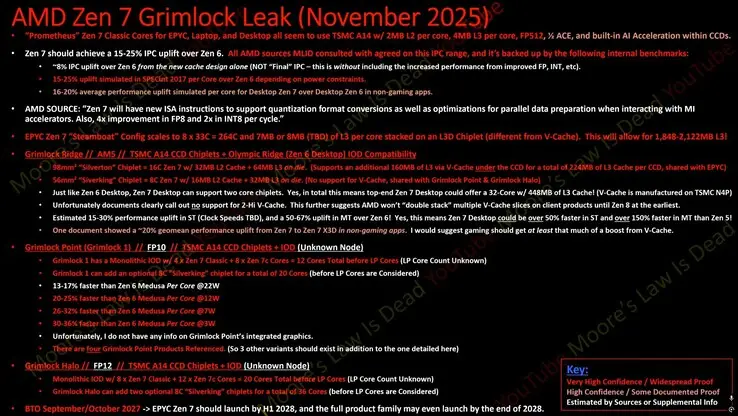
The first shocker? Zen 7 CCDs are reportedly getting fabbed on TSMC’s A16 node.
This isn’t just a small process shrink. A16 is the kind of bleeding-edge node that usually lands in ultra-premium smartphone SoCs before anyone else even gets a taste.
Each CCD can now pack up to 16 full Zen 7 cores, meaning dual-CCD desktop chips could hit 32 cores… on mainstream consumer platforms. That’s Threadripper-lite in Ryzen clothing.
Grimlock Ridge: The Desktop Lineup Sounds Nuts
AMD’s Zen 7 desktop family, codenamed Grimlock Ridge, will bring two chiplets:
✅ Silverton — The Absolute Beast
- 16 Zen 7 cores per CCD
- 32 MB L2
- 64 MB L3
- Supports 160 MB of 3D V-cache per CCD
Meaning if AMD ever makes a dual-CCD Ryzen X3D version…
You’re staring at 448 MB of extra cache.
Read that again.
Four hundred forty-eight megabytes.
This is “gaming advantage for days” territory.
✅ Silverking — The Trimmed Variant
- 8 Zen 7 cores
- Smaller caches
- No 3D V-cache
- Built mainly for efficiency-driven laptops
Silverton is expected in EPYC and the high-end Ryzen 13-series, while Silverking goes to thinner laptops and lower-wattage devices.
Oh, and a rumour already hints at a monster:
Ryzen 9 9950X3D2 dual 3D V-cache stacks.
Basically the final boss of gaming CPUs.
Laptop Chips: Zen 7 + Zen 7c + Low-Power Cores = Hybrid Madness
AMD isn’t holding back on laptops either.
The new Grimlock Point and Grimlock Halo APUs follow the same idea as Strix and Medusa, where different core types are mixed for better efficiency.
Grimlock Point (Mainstream Laptops)
- 4 Zen 7 cores
- 8 Zen 7c dense cores
- A few low-power cores sprinkled in
Grimlock Halo (High-end Laptops / Halo-tier APUs)
- 8 Zen 7 performance cores
- 12 Zen 7c dense cores
- Same low-power cluster
Basically, AMD’s going full hybrid architecture, similar to Intel’s P-core + E-core design, but with their own spin.
Performance-per-watt jumps:
- 36% at 3W
- 32% at 7W
- 25% at 12W
- 17% at 22W
This is huge for handhelds like ROG Ally or Lenovo Legion Go-like devices. Expect cooler temps and more battery without sacrificing fps.
Desktop Performance Gains: Real or Hype?
Early estimates show:
- 16–20% faster in non-gaming workloads
- 8% IPC bump (not final)
- Up to 20% better single-core
- Up to 67% better multi-core
If these numbers hold, Zen 7 might be the generational leap many were waiting for, especially for content creators and workstation users. Gamers get the mega cache advantage anyway, so they’re eating good regardless.
Conclusion
Zen 7 isn’t shaping up to be a small step. It’s looking like a leap — the kind that changes upgrade plans and pushes competitors into panic mode. Bigger cache, smarter hybrid design, better efficiency, and high-core-count mainstream CPUs? That’s a lot of boxes checked for one generation.
If AMD executes this right, 2026 might be the year Ryzen becomes the default recommendation again across desktops, laptops, and even handheld consoles.
Now you know what’s coming. The smart move? Keep an eye on every Zen 7 leak that drops, because the next few months might reveal even crazier surprises.
About The Author